| Nederlands | ![]() |
||||
![]() |
Mills in Altoaragón - harinero
Alquézar |
||||
| Alquézar is easily reached from Huesca and Barbastro. Halt just before
entering the village at the Ermita de San Antonio and walk the dirt road down.
Or, from the village center, follow the signposts fuente (mineral spring).
We had the luck that the owners of this mill invited us for a photosession inside.
The mill is on the Río Vero. There is an aceitero in the village center. Pictures: 29.XII.1994, 31.XII.1998 and 02.III.2003 |
|||||
![]() |
![]() |
|
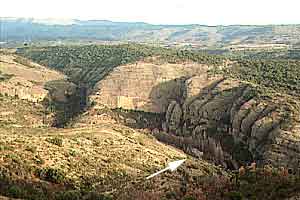
| Cañon del Río Vero with mill
seen from Ermita de San Antonio |
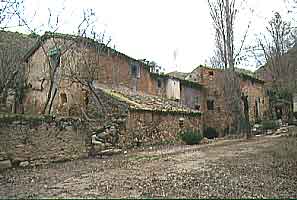
The mill proper is rightmost building with cárcavo just visible. |
| Quite a steep descent, but
once down there You will agree that a visit is worth every gasp on the way back.
The construction is very well preserved thanks to the efforts of the present
owners who bought the mill from the last miller in the 1960s.
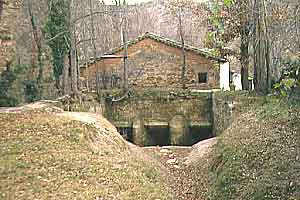
The mill proper with all the machinery is the rightmost part on the picture. The cárcavo indicates that the floor inside lies above ground level outside. The necessary steps are made from old mill stones. |
Walk past the mill and long the river
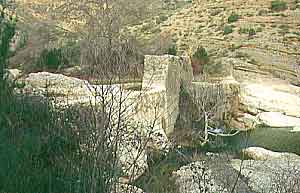
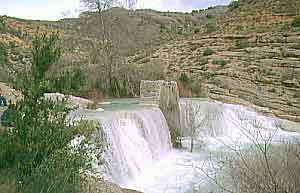
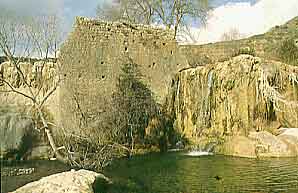
towards the enormous barrage (azud). There is more than its size that
strikes the eye. The central part is much higher than the rest.
Close inspection reveals that the wall is solid and not a leftover
of a bigger wall closing the complete river bed.
Better still, left and right half are not in line with each other. The barrage left from the central wall protrudes considerably. |
| azud | azud | |
![]() |
![]() |
![]() |
Antonio Naval Mas, in his work about
historical constructions
in the Somontano region, devotes several pages
to his educated guess about the meaning of this peculiar ground-plan.
It probably was the base of a batán. (Visit Abiego
for another impressive dam.)
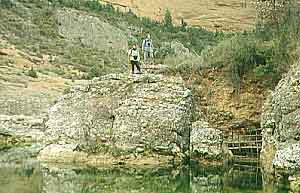
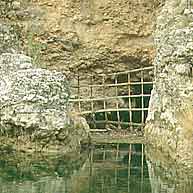
The channel takes its water from the right bank of the lake, about 20 m before the barrage. The inlet is protected by a grating. The first few meters are tunneled through the rock. |
|
| Central section of azud |
![]() |
![]() |
|
| Capture point of water moving the mill. | Grating keeping logs out. |
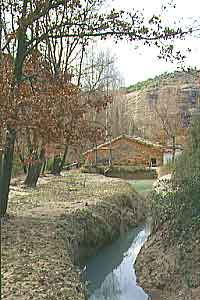
| The rest of the canal is wide and open. It passes the azud and at that point the wall features a nice pointed arch with a valve to drain superfluous water. From the azud to the mill a broad and high earthen wall has been thrown up. The largest part of the supply channel was dug out in this dam. | The canal ends in a reservoir made from excellent masonry (in fact much better than the rest of the construction). The water is drained through three funnels, saetines, deep below the floor of the reservoir (remember, we need sufficient pressure!) |
![]() |
![]() |
|
| Earthen wall supporting the canal. | Balsa with three inlets. |
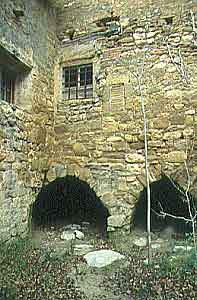
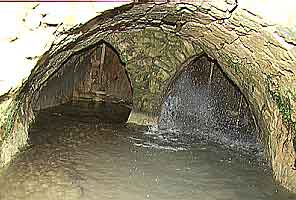
| As a consequence we would expect three outlets on the other side of the building, but that's not true. The southern wall shows only two arches. Everything becomes clear when we enter the left cavity. It hides two cárcavos each with a pointed arch. Each cavity housed the familiar horizontal wheel. | The last cárcavo features more recent modifications. There is a small concrete construction with valve and support for a metallic wheel on a horizontal (!) axle. A low ridge keeps the water to one side of the cárcavo. |
![]() |
![]() |
![]() |
||
| Canal ending in balsa | Outlet of the two cárcavos | Interior of right cárcavo |
![]() |
![]() |
|
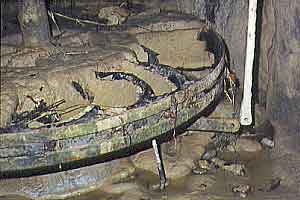
| Left outlet with two cárcavos | Wheel with wooden float-boards and levador |
![]() |
![]() |
|
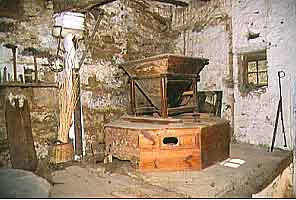
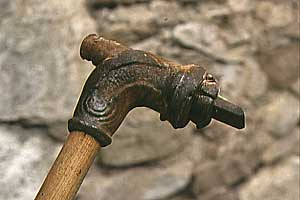
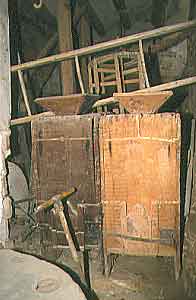
| Mill stone, cabra and dressing tools. | Octogonal guardapolvo with tolva. |
![]() |
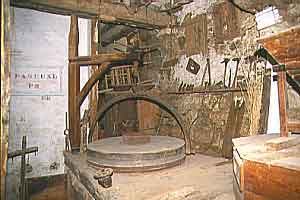
The interior is a miller's treasure cave.
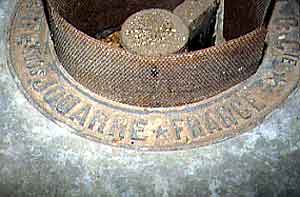
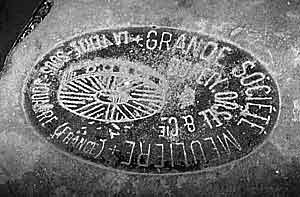
Although it would be a real challenge to make the mill corn-ready, most important things are preserved: machinery, storage, dressing tools. The floor gives plenty of opportunity to study different ridge patterns. The mill stones are from France. We recognize the mark of Grande Société Meulière Dupety-Orsel & Cie from La Ferté sous Jouarre. (Find another stone with the same origin in the Molino Cosme in Cortillas.) |
![]() |
![]() |
|
| Mill stone from La Ferté. | Mill stone from La Ferté. |
![]() |
||
| Storage with locks. |
|
Introduction Learn about the parts of a mill Visit the mills; catalogue Read more about mills; links © and e-mail: |
||
Go to the aceitero Next stop on the harinero trail |