| Nederlands | ![]() |
||||
![]() |
Mills in Altoaragón
Village mills in India |
||||
| The same type
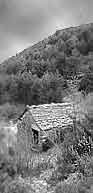
of small watermills like the one of Ainielle,
Paúles, Aso de Sobremonte
and many more are still very much alive in several parts of the world. There are believed
to exist a few hunderd thousand of such mills in the Himalayas. The examples shown
are from the Indian Himalayas in the Nainital region (Uttar Pradesh). The watermills
there are called gharats and have many things in common with the
mills in Altoaragón.
Pictures: XII.2004 |
|||||
| Pangot | Bajun |
![]() |
![]() |
|
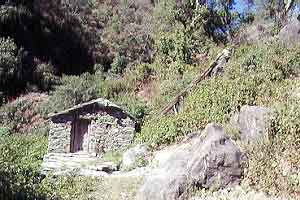
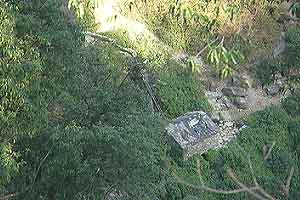
| The mill hidden in the valley. The supply channel and the chute is visible. |
The water falls 4 to 5 m down to the mill |
![]() |
The mills, like in Spain, are built with simple technology and local materials (the roof of the Bajunmill is made of flattened oil tins). The mills traditionally served the local communities but now often fall into disuse because of the very same forces that we've seen at work in the Pyrenees. The owners have gone to the cities to seek better employment. Industrial mills in nearby towns have killed business for the smaller village mills. And deforestation caused some water supplies to dry up. | |
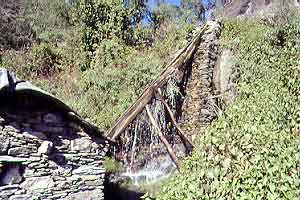
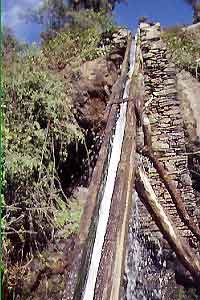
| Open chute brings water to the mill |
| Gharats lack the familiar pond to store water. They are situated in a region where getting sufficient water was much less of a problem than in most parts of Aragón. This is also illustrated by the fact that the miller here doesn't seem to care about considerable losses in the chute. | The door was locked, but the mill was running unattended. The mill in Bajun stood still. |
![]() |
![]() |
![]() |
||
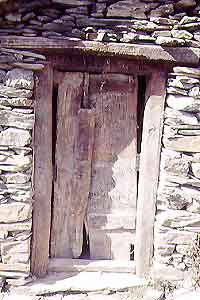
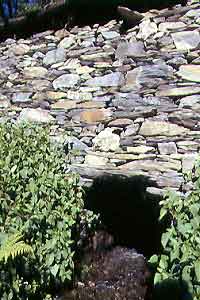
| Open chute | Entrance to the mill | The drain |
| Pangot | Bajun |
|
Introduction Learn about the parts of a mill Visit the mills; catalogue Read more about mills © and e-mail: |
||
|
|