| Path: Introduction - Visit the mills; catalogue - Centenera | ![]() |
Nederlands | ||||
![]() |
Mills in Altoaragón - aceitero
Centenera |
|||||
| Centenera is easily reached from
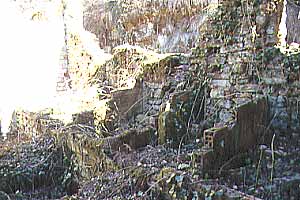
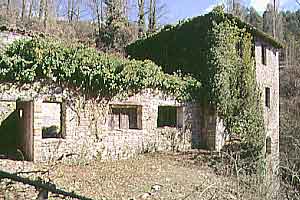
Graus. Leave Graus in northern direction towards Campo and Castejón de Sos. Turn right for La Puebla de Fantova. Once there do not enter the village, but continue straight-on towards Centenera and Abenozas. The construction is next to the road just before you cross the Barranco de la Ribera (or de Pinares). Our latest visit was on invitation of the owners who did quite a good job in removing the luxuriant vegetation, making it a much easier job for us than in 1998. Pictures: I.1998, 08.III.2004 |
||||||
| waterworks | harinero | aceitero | central eléctrica |
![]() |
![]() |
| The aceitero is installed
in the left part of the construction. The entrance (left most on the picture)
is situated away from the road. When you enter you first come into
a short gangway leading to a small room lined with what I think were fodder-troughs.
It's a feature that we've seen before. The ruello to crush the olives
was turned around by a mule and this was the place where the animal
could take a quick snack. But as this mill was highly motorized, the
trough probably wasn't in use anymore. |
Then you'll step into the
main room of the oil mill were all activity was centralized. A row of algorínes (containers
to stock the fresh olives waiting to be processed) is situated at your left hand
against the road-side wall. The bricks betray some more recent repairs.
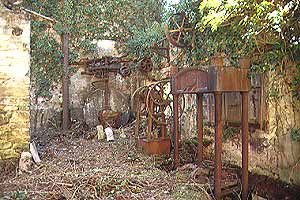
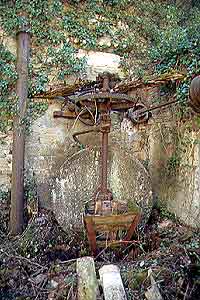
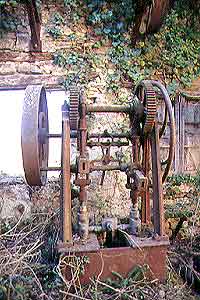
All the machinery is installed in a line against the opposite wall. In the corner in the depth is the ruello resting in its balsa. We have seen a similar contraption in the mill of Troncedo where I've also explained how it works. The cog-wheels there are absent though, because the system in Troncedo was driven by energía de sangre (a mule as we call it). The press is of a very modern make. The oldest type of press is of the cantilever-type and asks for a long room and a high roof (e.g. Castilsabás, Trillo, Fumanal and Coscojuela). Other sites like Troncedo and Almazorre feature a space saving device which is still based on a screw to force a plate down onto the heap of mats with olive-mash. |
||
![]() |
|||
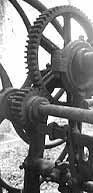
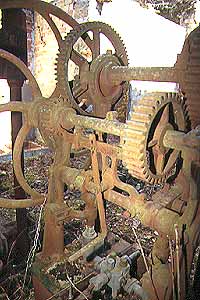
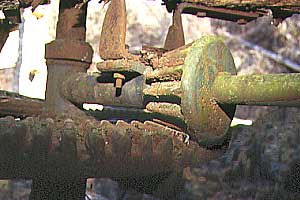
| Our system here is a hydraulic press. The system consists of two separate devices : the press proper (foreground of picture) and a pump to build up the pressure (see below). The bottom plate of the press is mounted on a hydraulic lift. This plate is pumped upwards to squeeze the olive oil out. | The miller could choose between two gears and also between manual or motorized operation. Look at the pictures to appreciate the switching handle, the ratios between the wheels and the excentric sheave needed to create the up-and-down pumping movement. Oil was forced from the box forming the foot of the pump to the lift under the press through a system of tubes. |
![]() |
![]() |
![]() |
| Ruello to crush the olives | Hydraulic pump | Gearbox of the pump |
![]() |
![]() |
|
| Pinions of the ruello | Brandlabel of the press |
| The tubes form a circuit. A tap in the
return tube made it possible to lift the pressure by allowing the oil to flow back to
the reservoir.
A similar system is on display at one of the plazas in Castillazuelo, a village in the Somontano de Barbastro region. It is another brand though. |
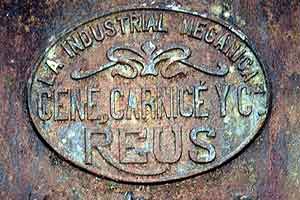
I couldn't find a label on the
pump, but the press features one. It says:
Cené, Carnicé Y Ca REUS |
![]() |
![]() |
![]() |
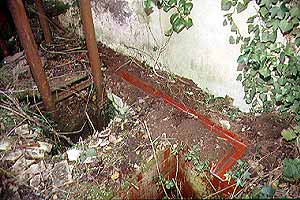
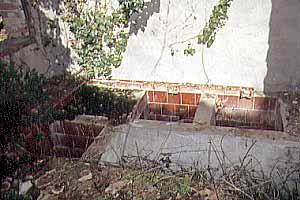
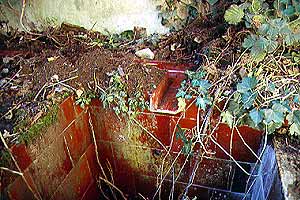
The fresh olive oil was captured in a gutter leading towards four reservoirs necessarily below floor level. A rectangular part of the floor is digged out and provided with some stairs to provide a more convenient access to this pilas. |
| waterworks | harinero | aceitero | central eléctrica |
|
Introduction Learn about the parts of a mill Visit the mills; catalogue Read more about mills © and e-mail: |
||
Path: Home / Altoaragón: old mills |