| Nederlands |
![]() |
|||
![]() |
Mills in Altoaragón - harinero, aceitero
Palo |
|||
|
||||
| harinero | aceitero | museum site |
![]() |
![]() |
|
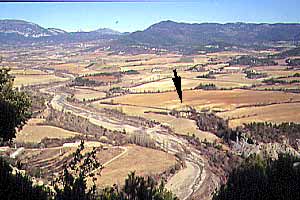
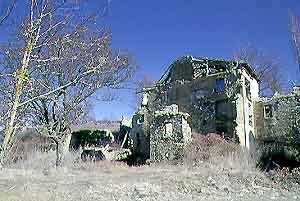
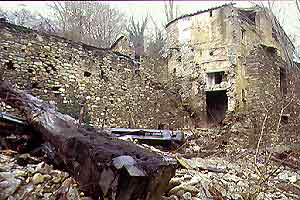
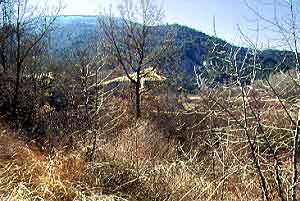
| (1) The mill of Palo in the landscape | (2) The mill in 2005; highest part = harinero; behind the tree = aceitero |
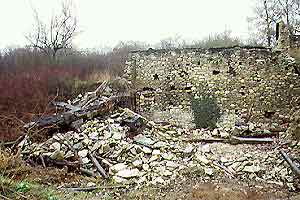
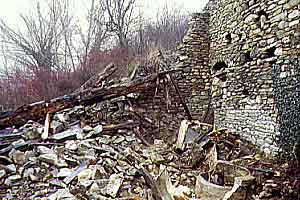
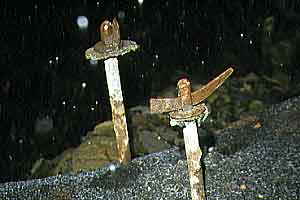
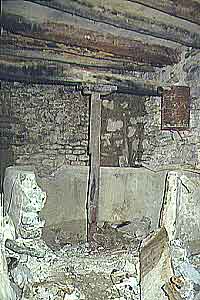
| The aceitero was razed to the ground in 1996 not too long before our visit. I wonder why, because the site in 2005 doesn't look much changed. | Parts of the wooden press were dispersed all over the place and showed the effects of fire; tiled containers (pilas) were broken; a real pitty. |
![]() |
![]() |
|
| (3) The aceitero in 1996 | (4) The aceitero in 1996 |
![]() |
![]() |
|
| (5) The aceitero in 1996 | (6) The aceitero in 2005 |
![]() |
![]() |
|
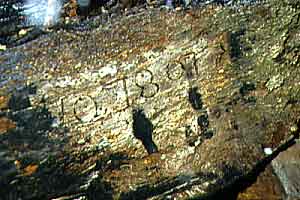
| (7) Some nails of the press | (8) Año 1807 |
![]() |
Behind the opening in pict. (4)
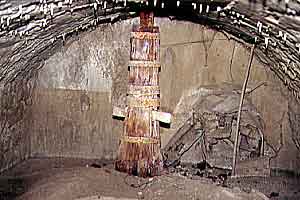
only one part of the industry barely survived the rage: the balsa where the olives
were crushed before they were put under the press. (Read more about the procedure.)
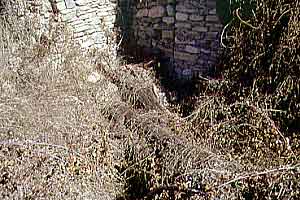
The balsa has very high walls; in most cases the border is only some centimeters high (e.g. Troncedo, Coscojuela). The central axis is of wood and is driven by water power. A nice wooden axis (with equally wooden (?) rodete) is resting in the cárcavo below the floor. Thus this mill had three rodetes mounted in two cárcavos. This asked for a lot of water. The mill therefore was equiped with an enormous reservoir situated behind the walls of both the aceitero and the harinero (see 3, 4, 11). The supply channels are filled up; I couldn't find any trace. |
|
| (9) The balsa in 1996 ánd 2005 |
![]() |
![]() |
|
| (10) Inside the cárcavo of the oil factory |
(11) The water reservoir; the wall is the back wall of the aceitero |
| harinero | aceitero | museum site |
|
Introduction Learn about the parts of a mill Visit the mills Read more about mills © and e-mail: |
||
|
|