Mills in Alto Aragón - harinero, central eléctrica
Sercué
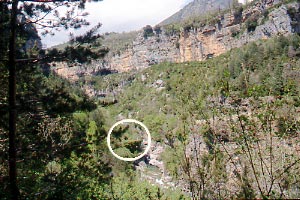
Leave L'Ainsa towards Bielsa and the French
border. Turn left in Escalona and follow the road toward the
famous
Garganta del Añisclo (Vallée
de la Niscle for the French) until you
reach the parking-space. From there follow the walk
Molino de Aso.
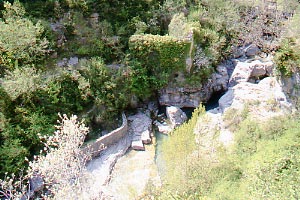
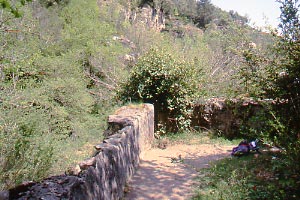
The path descends into the canyon and about half way down there is a branch.
Don't believe the signpost waving you away to the left. That path brings you
only to the remains of the water supply channel. Take right and you'll find
the front door very soon. Though the molino is very ruinoso, each map of the region
indicates its position.
Pictures: 30.iv.2002
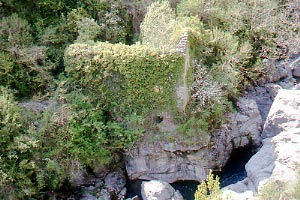
What is now called the Molino de Aso are the remains
of the lowest of both mills of Sercué (and Nerín, because
both villages together owned them). The upper mill is gone. Wilmes
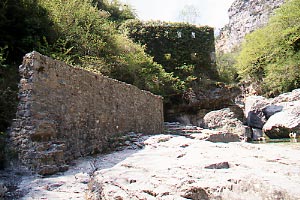
describes the mill with only one floor and a small open window exactly as we
find it on Briet's picture. The second floor, the many windows, the power generator
are later additions.
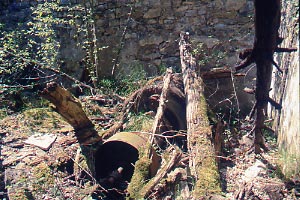
Trees are sprouting
everywhere inside and it is only because of the many visitors that the interior stays
more or less accessible.
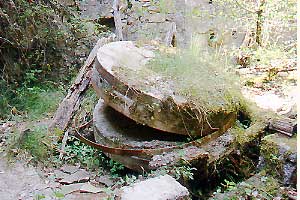
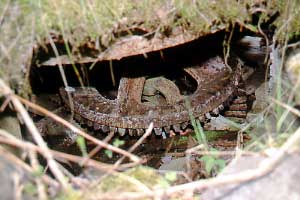
The room is empty except for the really heavy stuff like a couple of milling stones.
The harinero is situated nearest to the entrance (away from the river).
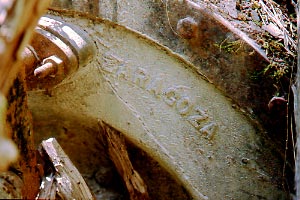
The power generator is situated against the wall lining the river.
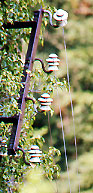
On the wall a line of isolators with some wiring emerges from the ivy.
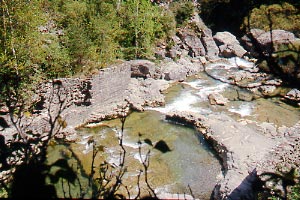
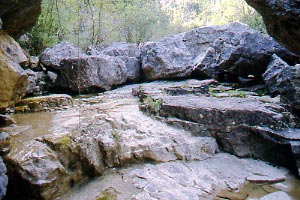
When you walk back and take the left branch of the path, you will
reach the river crossing. That's where it's worth the effort to
wander a bit between the rocks to study the old intake point and the
remains of an old reservoir.
In 1995 El Gurrión (N°59 of a quarterly magazine based in Labuerda) published a short
interview with Ramón Naval, the last man who ran the Molino de Aso. Rafael Latre
talks with him.
Nombre, edad y lugar de nacimiento:
—Ramón Naval, 65 años, nacido en Puyarruego.
¿Cuantos años ha trabajado de electricista y durante cuánto tiempo en el Molino de Aso?
—Cuarenta y tres años: 28 años para la empresa AUXINI y 15 para Nuñez. En Aso 10 años
¿Cómo adquirió los conocimientos que tiene?
—Mediante interés personal, experiencia y apoyo en algún texto eléctrico.
¿Qué trabajo llevaba a cabo en el Molino de Aso?
—En primer lugar efectué el montaje de las líneas de suministro a los pueblos. Luego
instalé la líneas de baja tensión en las viviendas. Después atendí
el funcionamiento de alumbrado de los pueblos y molí el grano que los vecinos cosechaban.
¿Recuerda momentos buenos y malos en el transcurso de aquellos años?
—Buenos la regularidad del trabajo. Malos las incomunicaciones en invierno por nevadas.
¿Cuántos pueblos se alimentaban de la energía eléctrica producida en Aso?
—Sercué, Nerín, Vió y Buerba.
¿De qué potencia máxima se disponia?
—Para caudal medio-alto: 10KW. Para caudal minimo 5KW.
¿Cómo era el Molino? ¿Había vivienda para usted?
—Era (hoy está en ruinas) una casa construida con piedras, con vivienda en la planta superior.
La vivienda no estaba muy bien acondicionada. Me solía quedar en invierno.
La planta baja contenía las máquinas
y las piedras para moler el trigo.
¿El suministro de energía era continuo durante las 24 horas del día?
—No. Exclusivamente nocturno. Exceptuando peticiones por fiestas y otros acontecimientos locales.
¿Recuerda el último año en que hubo suministro de electricidad?
—Si. Esto sucedió en 1970.
¿Por qué dejó de funcionar el Molino?
—Por la espectacular reducción en el número de abonados a causa de la emigración.
¿Puede decirnos, por último, alguna curiosidad de aquella época?
—Cuando molia grano dejaba sin corriente a los pueblos. La explicación estaba en la poca potencia
que producía el salto. El consumidor venía a pagar una peseta por KWh consumido.
Name, age and place of birth:
—Ramón Naval, 65, born in Puyarruego.
How many years did You work as an electrician and how many in the mill of Aso?
—Forthy three years: 28 for a company named AUXINI and another 15 for Nuñez. In Aso I worked for 10 years.
How did you acquire the necessary competences?
—Because I was interested I was able to learn much at the job and helped by some reading about electricity.
Can you describe your tasks at the Molino de Aso?
—First I worked at the main lines towards the villages. Done that I installed the lower voltage
lines into the houses and I kept an eye on the public lighting. I also did the milling
of the local harvest.
Can you tell us about some good or bad memories of all those years at the mill?
—A good thing was the regularity of the work. What I didn't like was the isolation
because of the snow during the winter.
How many villages got their energy from Aso?
—Sercué, Nerín, Vió and Buerba.
What was the maximum output you could deliver?
—When there was plenty of water: 10KW. During dry periods only 5KW.
How was the mill? Where there provisions for you to overnight there?
—Today the mill is in ruins. At the time it was a house made of stone and with living quarters at the upper floor. The house
wasn't very well appointed and I usually stayed there only during the winter.
The bottom floor housed the machinery and the stones for the wheat mill.
Was there a continuous supply of electricity?
—No. Only during the night or on request for local festivities or other special occasions.
Do you remember the last year when the mill produced electricity?
—Sure, that was in 1970.
What was the reason to shut down the mill?
—Emigration caused a spectacular drop in the number of subscribers to the service.
Can you provide us with a interesting titbit or two to conclude this interview?
—During the processing of grain the villages had to do without light. There wasn't simply
enough water to run the stones and the generator at the same time.
People had to pay the price of one peseta per KWh.