| Nederlands | ![]() |
||||
![]() |
Watermills in Altoaragón - aceitero
Trillo |
||||
| Trillo's mill is most easily reached
from the main road between L'Ainsa and Barbastro. Turn left in Mesón de Ligüerre de Cinca to La Fueva and Palo. The road goes up then down into the valley
of the Río Cinca and then steeply up again to cross the ridge which borders the Fueva region. Pass the branch where Samper is indicated. Look now for a dyke at the right.
At the end of it is a sandy track leading to a flat behind the ridge where you can leave your vehicle. You'll know that you've missed the spot when you are over the top.
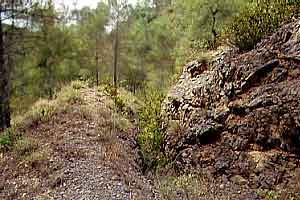
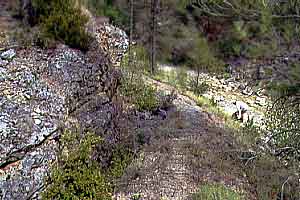
At the far end of the plateau starts the path leading to the mill. There is a split
after the first few meters. Follow the right branch which first stays level and then
goes down fast to the Barranco de Salinar de Trillo.
Pictures: 3.VIII.2004 and 8.III.2005 |
|||||
| waterworks | aceitero |
![]() |
![]() |
|
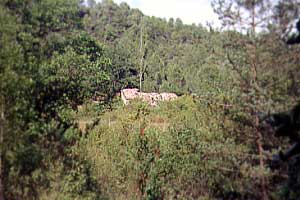
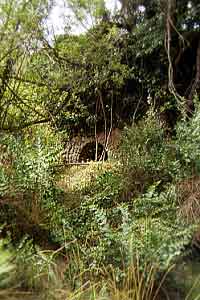
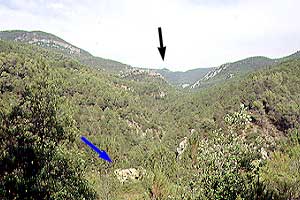
| (1) Watermill with Trillo and Troncedo. | (2) Aceitero of Trillo |
| Most of the way down is trough mixed forest with pretty dense undergrowth. But at a few places you can leave the path to get a view over the valley with the mill at the bottom. In the background you'll notice the village of Trillo and far away the buttress with the castle ruins of Troncedo (black arrow). | The mill is situated at the base of a flat terrain at the confluence of the Barranco de Sta Brigida with the Barranco de Salinar de Trillo (old salt-works in Salinas de Trillo). The entrance is at the left side. The embalse is situated at the opposite side. |
![]() |
A short walk streamup in the riverbed
is the best way to the cárcavo, that most sacred part of any mill.
If you are interested in plants you'll notice the remarkable Coriaria myrtifolia. You won't find it often in the region, but it's abundant here. It's named Emborrachacabras in Spanish, meaning making the goates drunken.
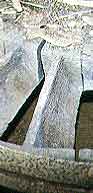
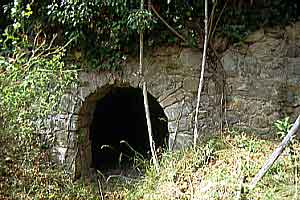
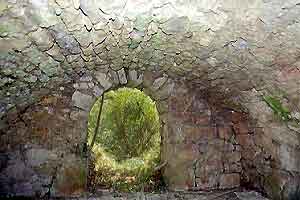
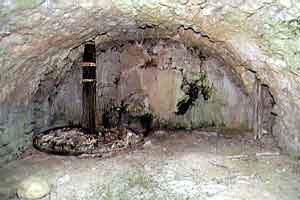
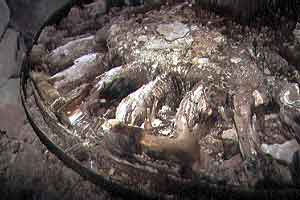
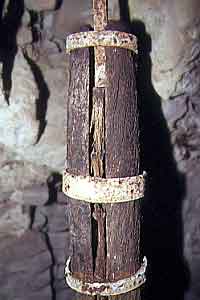
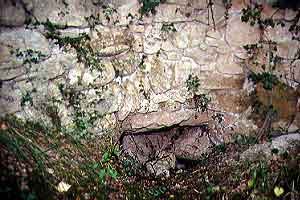
The outlet is a fine arch built in excellent masonry. The cárcavo itself is much wider than suggested by the outlet. It's a spacious room with one eccentric wheel. (Find a similar situation in Javierre de Olsón and Mondot.) The wheel is of wood. Even the axis is still made of wood (Javierre de Olsón's axis is of iron.). But as the wheel is resting on silt, the blades are almost entirely rotten away. I wonder if the second position ever was occupied by a wheel. In my opinion there is not enough free space in the workroom. |
![]() |
![]() |
|
| (4) Outlet of the cárcavo | (5) Interior of cárcavo |
| waterworks | aceitero |
![]() |
![]() |
|
| (6) Cárcavo houses one wheel | (7) Wheel with wooden blades |
![]() |
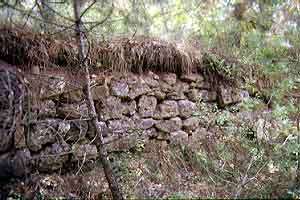
The embalse (the reservoir) lies
against the backwall of the cárcavo. Earthen dams are reinforced
with stone walls and masonry (pict. 11, 12). The saetín (brings water to the wheel via the botana) is situated about four meters below the surface.
Two channels brought water to the reservoir. |
| waterworks | aceitero |
![]() |
![]() |
|
| (9) Supply channel | (10) Supply channel above the barranco |
![]() |
![]() |
|
| (11) Wall of the embalse | (12) Inlet = saetín |
| waterworks | aceitero |
|
Introduction Learn about the parts of a mill Visit the mills; catalogue Read more about mills © and e-mail: |
||