| Nederlands |
![]() |
|||
![]() |
Mills in Altoaragón - harinero
Javierre de Olsón |
|||
| ||||
| waterworks | lower harinero | upper harinero | aceitero |
![]() |
![]() |
|
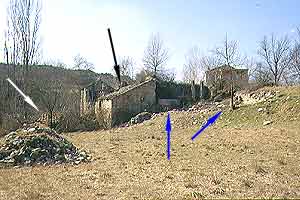
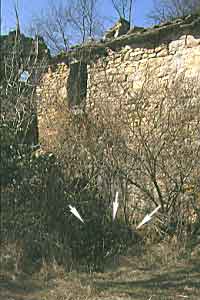
| Overview of the site black arrow points to upper harinero. |
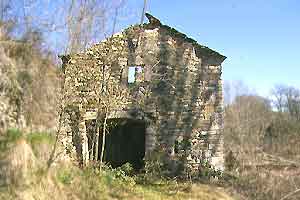
entrance of upper mill left: the wall of the embalse |
| The upper harinero rests against
the wall of the embalse which reaches the roof of the mill. The roof collapsed, the
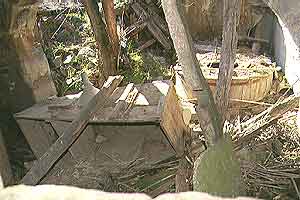
workplace is in disarray and what's left of the tools lies scattered around. Notice
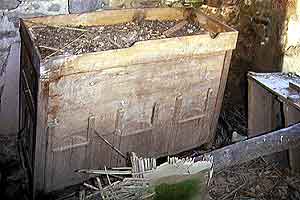
the cilindrical guardapolvo and the impeccable torno.
The torno is a tool typical for places where bread was made - bakeries, large family houses, and also several mills (e.g. Castillazuelo, Centenera, Yésero, etc.) |
The torno is a bolting machine used to split the flour into three fractions : very fine (minudillo), fine (cabezuela) and coarse (tercera) corresponding with the three valves. A crank comes out of one of the short sides. At the inside of the box this crank is connected with an axis mounted between the short sides. An octagonal prism is fitted to this axis which is slightly off horizontal. The prism is lined with gauze with a different mesh for each section. Small mallets of wood inside the prism kept the flour off lumping while the crank was operated. |
![]() |
![]() |
|
| workplace in disarray | torno = bolting machine |
![]() |
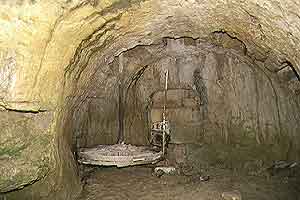
Although the vegetation asks
for quite a bit of grooming before allowing you access to the cárcavo, you'll
agree that it's well worth the effort after you have been inside.
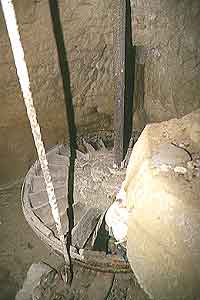
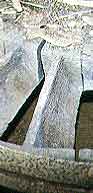
The cárcavo is very deep and spacious and contains only one rueda. The botana (nozzle) is mounted on a protruding section of the back-wall. It's all very similar to the situation in the molino Villacampa of Mondot in the same valley. The big difference is the material of the wheel : iron in Mondot and wood here. |
![]() |
||
| outlet | rueda, botana and levador |
![]() |
![]() |
|
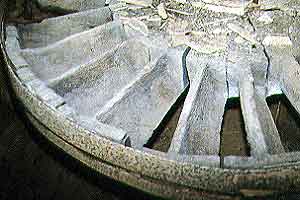
| Cárcavo with ample room | detail of the rodezno made of wood |
![]() |
We've seen wooden wheels at very few
sites (e.g. Ainielle,
Torrolluala) and we were either
kept away by a protective grid or the wheel was fallen into pieces. This wheel however
is in perfect condition and you can touch it to appreciate the fascinating craftmanship.
Look at the shape of the individual blades.
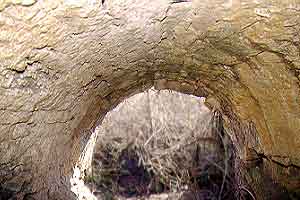
The water was evacuated through a wide channel leading to the lower harinero only a few meters away but hidden behind the scrub in the channel. |
|
| Cárcavo looking at the lower mill |
| waterworks | lower harinero | upper harinero | aceitero |
|
Introduction Learn about the parts of a mill Visit the mills Read more about mills © and e-mail: |
||