| Path: Introduction - Visit the mills; catalogue - Espés bajo | ![]() |
Nederlands | ||||
![]() |
Mills in Altoaragón - harinero, central eléctrica
Espés bajo |
|||||
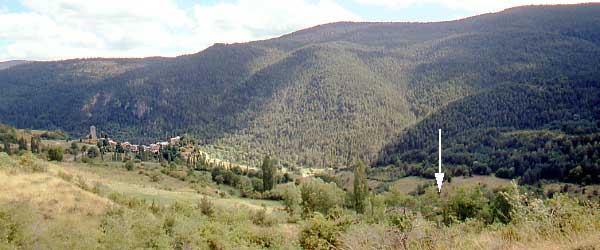
| Espés bajo nowadays is easily reached from the
main road between Castejón de Sos and Pont de Suert. Coming from Castejón You'll
first have to negotiate the Collado de Fades (almost 1500 m) and then look out for the branch
towards Abella and Espés. Do not enter the village of Espés bajo, but instead
take the road down into the valley. At some point the GR crosses the road. Follow this markings to
the west and You will soon arrive at the mill. In the likely case that You miss the GR drive the narrow
road down to the river crossing. You can now walk along the river against the current and will
soon find the mill. The mill taps water from the Barranco de Espés. Pictures: 16.VIII.2007 |
||||||
| waterworks | harinero | central eléctrica |
![]() |
|
| (1) Espés bajo — arrow indicates approximate location of the mill in the valley |
![]() |
![]() |
||
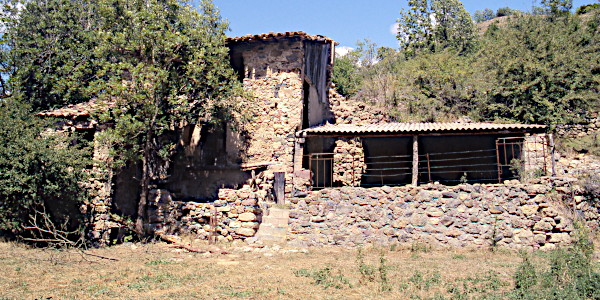
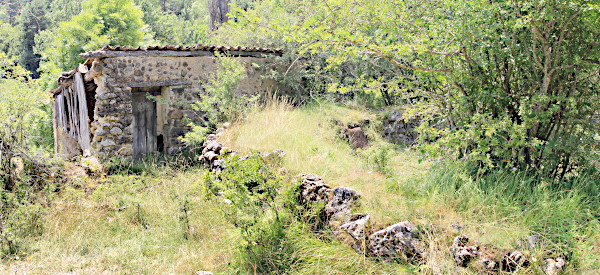
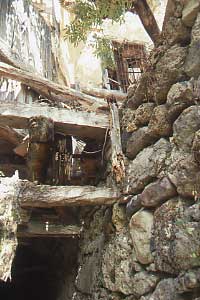
| (2) Mill seen from the river- front | (3) Mill seen from the GR - back | ||
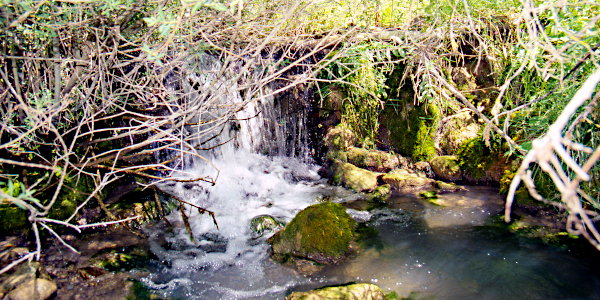
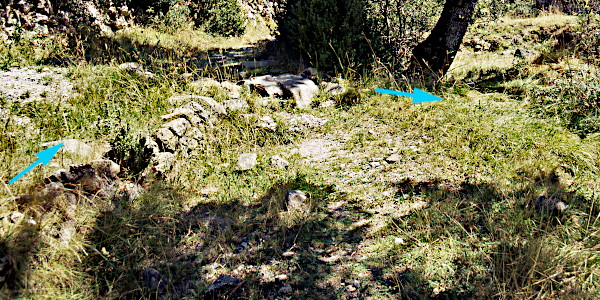
| The dam is quite easily to find. Walk to the back of the mill to meet the GR hiking track (5) and from there follow the path to the West. At the river walk against the current and You'll soon find the dam (4) which is rather humble and hidden below the shrub. It is a pleasant walk and the landscape is so inviting that You probably will want to explore more of the surroundings. | From the dam a shallow channel runs towards the mill. Only the first
stretch still carries water and feeds a lush vegetation. Arriving at the mill, the canal takes a turn, dives
below the path (5) and then opens into the reservoir (6).
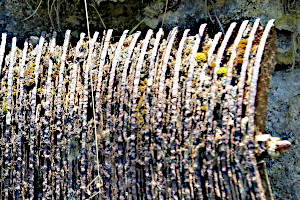
The pond is quite large and probably not without reason. First there were two hungry turbines (8). |
![]() |
![]() |
||
| (4) Azud, or dam, hidden below vegetation | (5) Canal just before the pond | ||
![]() |
Second because the river Espés —which is in fact rather a rivulet—
probably never carries enough water to moler de fila. Moler de fila means that water from
the river is directly fed to the turbines, without the help of any device
to store the water first. This was normal practice along the Río Ara:
see f.e. Broto, Fiscal,
Guaso, or Jánovas.
But here however, waterstorage was a necessity.
The embalse lies even with the top floor of the mill (6). A large grating stops objects from entering the turbines. |
||
| (6) Water reservoir at the back of the mill | |||
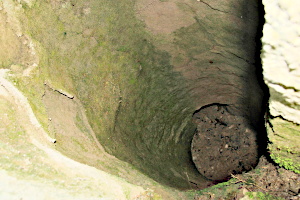
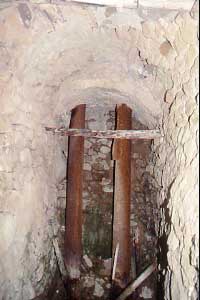
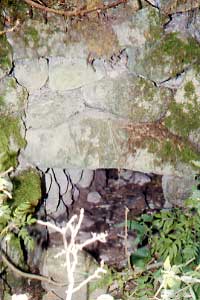
| After the good work, the water is led back to the river by means of a tunel below the pastures. The start of this tunel can be seen from inside the cárcavo (9) | The cárcavo (7) is situated between both sections (wheat and power) of the mill. It's narrow and very deep. When You climb down You'll find that it's empty apart of the drainpipes (8) of the turbines. |
![]() |
![]() |
![]() |
| (7) Cárcavo | (8) Drainpipes of the turbines | (9) Start of drain below pasture |
| waterworks | harinero | central eléctrica |
|
Introduction Learn about the parts of a mill Visit the mills; catalogue Read more about mills © and e-mail: |
||
Path: Home / Altoaragón: old watermills |