Mills in Alto Aragón
harinero, central eléctrica

Fiscal

Fiscal is situated near Ordesa National Park. Find Fiscal on the main road between L'Ainsa and Broto – Torla. From the main road, cross the river towards the village centre. You'll find the mill at the other side, just around the corner. The open air museum for the batán of Lacort lies opposite. The mill took its water from the Río Ara.

When we first visited the mill, locks and bars kept people out but rain and wind had free reign through the broken windows. Since then maintenance and improvements have been carried out and the mill is now open as a tourist information center during the summer months.

Pictures: 26.xii.2001, 22.viii.2006, 18.i.2022
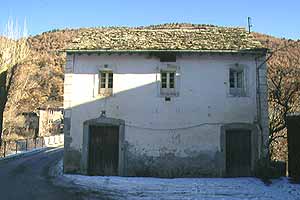
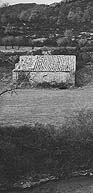
(1) The mill in december 2001
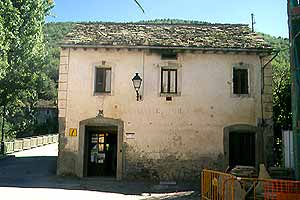
(2) The mill in august 2006

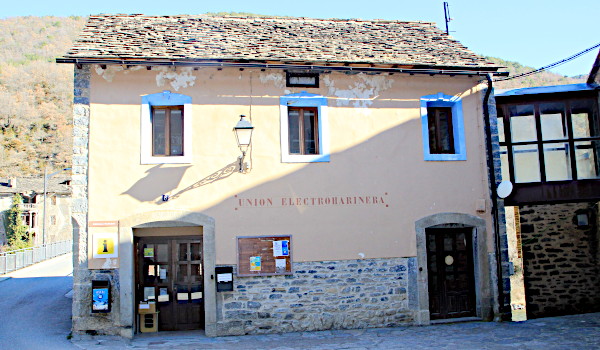
(3) The mill in january 2022.

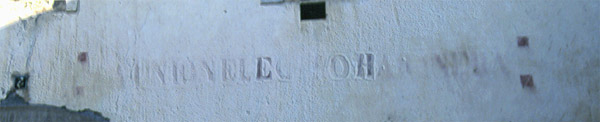
(4) The old version of La Union ElectroHarinera on the front wall.

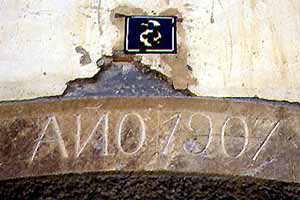
(5) The lintel of the door shows the year 1907
Take a look at the front wall before you enter the Tourist Information Center through the left door. The lintel (5) of the door carries the year Año 1907 (exactly 100 years later than the molino of Sieste).

Currently the text on the wall
 Union ElectroHarinera 

is very clearly visible (3). However, earlier photos (1, 2, 4) show that the text in former times was much wider. The text then began above the entrance (notice the red dots) and reaches almost to the door at right.

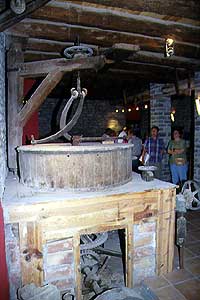
Iinside you'll find a hurst frame with one couple of millstones against the wall right from the entrance. While some essential parts are missing (e.g. the hopper to load the grain) the unit in general is very well preserved. We've noticed a nice stone case (guardapolvo) and a peculiar crane (grua).
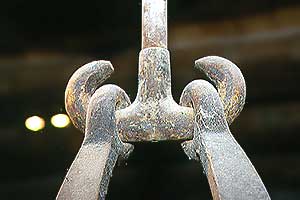
A crane (6, 10, grua, cabra) of this type, with free moving arms, is rarely seen in this region. In most other mills the bails which will lift the runner stone are bolted together and can therefore move only in one plane and not be taken away without tools. Here they can move with much more freedom and be lifted from their hook in an instant.

(6)
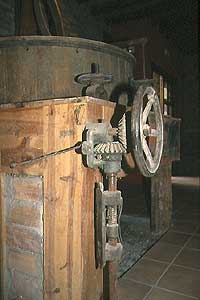
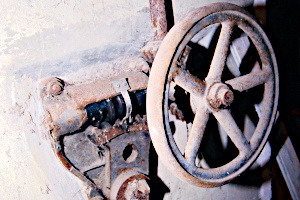
(7) Flow control (connects with 9)
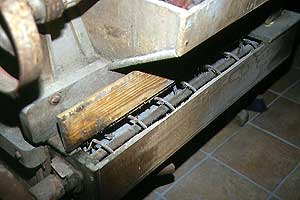
(8) Chute and gearbox

(9) Flow control of the turbine (in the basement)
It was possible to control the water flow from this floor. The wheel (7) is via pinions and a long pole connected with the gauge (9) in the basement.

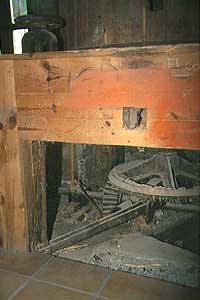
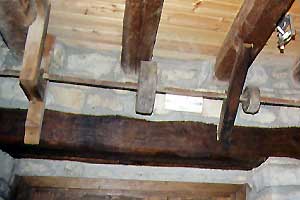
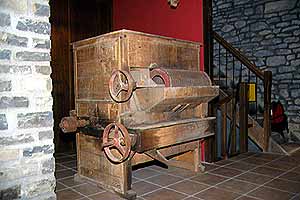
Belts ran from the basement to a distribution system consisting of axles with wheels of different sizes. Parts of this system are still visible against the ceiling (11). It kept the stones but also other tools going (e.g. a grain cleaner 12, 13).

(10)
(11)
(12)
(13)

(14)
(15)
(16)

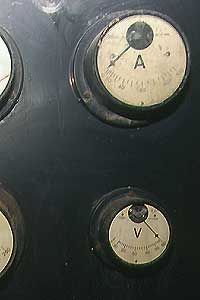
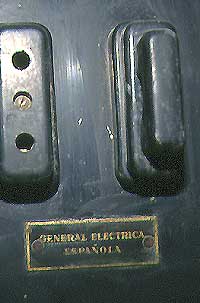
The electricity part of the mill didn't survive that well. A board with some dials (14) and fuses (15) was resting against the wall and that's all.

A tag reads General eléctrica Española (15).

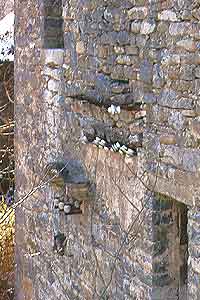
The back wall of the mill is amply provided with insulators. Old maps of the 1950s show powerlines reaching towards Asín de Broto, Lardiés and on the right riverbank as far as Liguerre de Ara. Earlier on, several villages in the Solana (e.g. Muro, Sasé) got also their light from Fiscal (see Baselga Abril).


Find a picture of the mill of Fiscal dated 1912 in:
Franceses en Sobrarbe - un turismo diferente
Centro de Estudios de Sobrarbe - 2006
Dep. legal Z-2755-06

 This brochure is available on line: download PDF (latest check 16.i.2026).

Cross the road to the fulling-mill of Lacort.
Path: Home / Alto Aragón: old mills / Fiscal
Introduction
Learn about the parts of a mill
Visit the mills; catalogue
Literature and other websites
© and e-mail: