| Path: Introduction - Visit the mills; catalogue - Torrolluala del Obico | ![]() |
Nederlands | ||||
![]() |
Mills in Altoaragón - harinero
Torrolluala del Obico |
|||||
| Torrolluala del Obico is situated near the
Puerto del Serrablo. Take the main road between Boltaña and Lanave and leave the car
at the parking plot where the path to Torrolluala is indicated. Just follow the sand and stone track
and after a healthy walk you'll reach the branch to the abandoned village. Keep to the other
branch which will bring you down into the valley of the Barranco de San Juan.
There will be a smaller track branching to the left which leads to the water.
Cross the rivulet and walk the path against the current. The watermill is nearby.
Alternatively, switch track when you come at the sign which shows the path to Morcat. It runs next to the azud from where the mill is only a few steps away. |
||||||
| workplace | waterworks |
![]() |
|
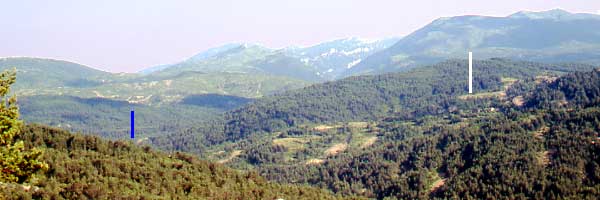
| (1) Torrolluala del Obico (white stroke); blue stroke gives approximate location of the mill |
![]() |
|
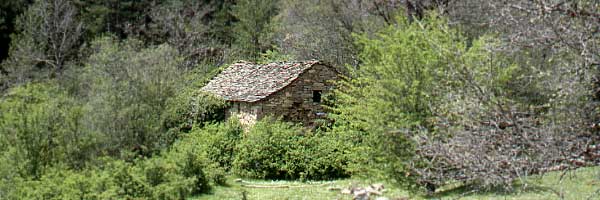
| (2) Torrolluala del Obico: the mill still in perfect condition — 1995. |
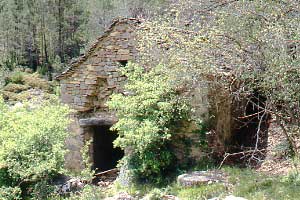
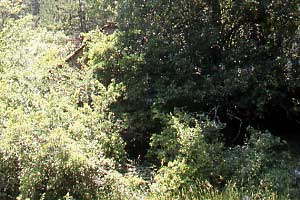
| The mill at the time of our visit in 1995 was still very solid. The roof had no leaks, the wall no gaps. The front wall lost a batch of stones (3), but some supporting sticks in the void seem to suggest that the missing stones were removed rather than fell out. | Back then I wrote It won't take long though before the vegetation will claim possession of the construction. That's exactly what happened — Agreed, it wasn't such a difficult forecast. The building is almost completely hidden below the trees (4). |
![]() |
![]() |
||
| (3) façade in 1995 | (4) façade in 2010 | ||
![]() |
![]() |
||
| (5) workplace in 1995 - larger picture | (6) workplace in 2010 | ||
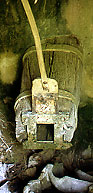
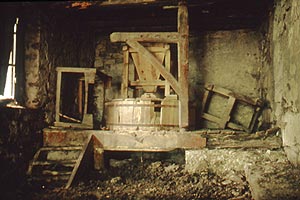
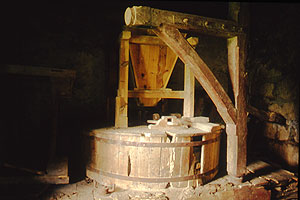
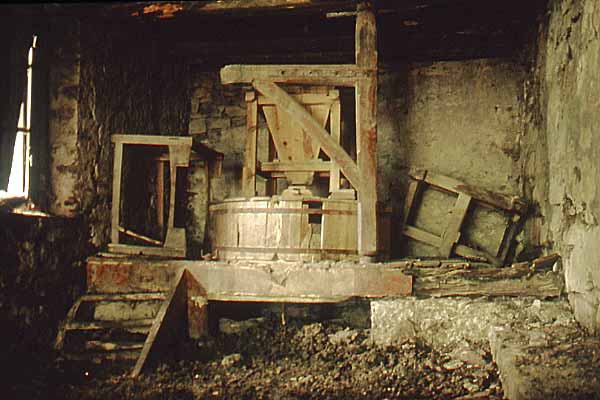
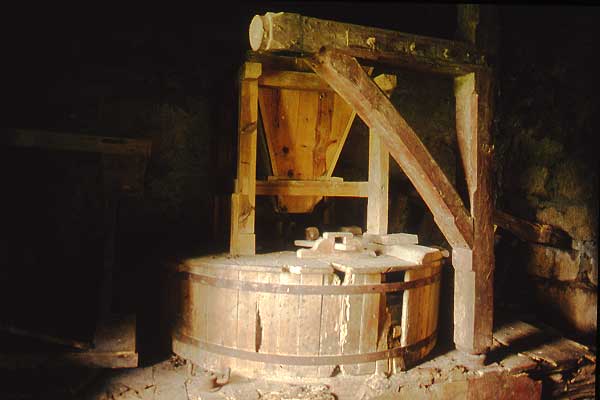
| The workplace, in 1995, wasn't very clean. The door stood open and cows aren't the best house keepers, but the milling frame at the back was very well preserved (5). It is a configuration which is often found with some steps leading up to a platform which receives light from a window looking out over the drain (e.g. Sarsa da Surta, Bara or Las Almunias de Rodellar). Notice the dust covering (guardapolvo), the stone crane (grua with cabra), the feeding hopper (tolva) which is rather slender compared to the aforementioned mills, the handle to set the space between the stones (levador), it's all there! (7) | It's therefore really hard to cope with what we met in 2010: the
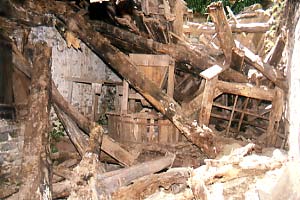
room is a shambles (6). The roof above the milling frame crashed. The crane followed suit. The tolva withstands the
pressure, but for how long? The fungi are hard at work. Disastrous and shameful.
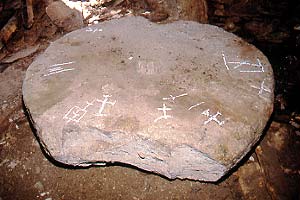
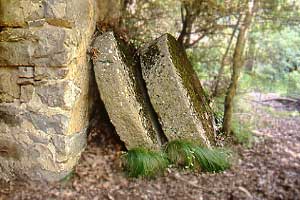
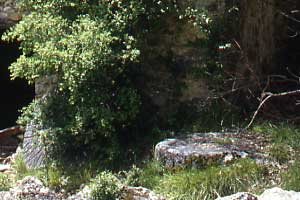
An eroded decommissioned stone (8) rests nearer to the entry. It's covered with quite some glyphs: crucifixes in different sizes and shapes (see also Solanilla). Three stones more are put aside outside: one (10 left) features a more modern ridge pattern, none is a modern composite stone. |
![]() |
![]() |
||
| (7) milling frame in 1995 - larger picture | (8) decommissioned milling stone — ∅ = 135cm | ||
![]() |
![]() |
||
| (9) decommissioned stones at the door | (10) and another one | ||
| workplace | waterworks |
|
Introduction Learn about the parts of a mill Visit the mills; catalogue Read more about mills © and e-mail: |
||
Path: Home / Altoaragón: old watermills |