| Nederlands | ![]() |
||||
![]() |
Watermills in Altoaragón - central eléctrica
Broto |
||||
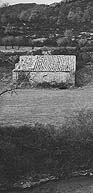
| Broto is situated
near Torla and the Ordesa National Park. You'll find the mill
at the northern outskirts next to the village church.
The mill takes water from the Río Ara. Pictures: 1.III.2007 |
|||||
| waterworks | powerstation | wheat mill |
![]() |
![]() |
|
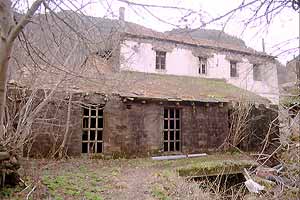
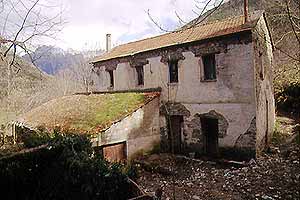
| Powerstation (left, lower) with harinero | (12) Central eléctrica with drain (right) |
| I was quite impressed when I entered this part of the mill of Broto. I'm used to much smaller setups. However, according to the International Energy Agency this setting still is a micro hydroelectric station because it has a capacity of not more than 100KW. | The electric station is built next to the corn (wheat) mill and facing the river. The floor is lowered because the entrance of the turbines must be as low as possible compared to the supply channel. The floor is level with the bottom of the cárcavo below the harinero. |
![]() |
![]() |
|
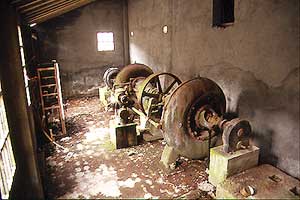
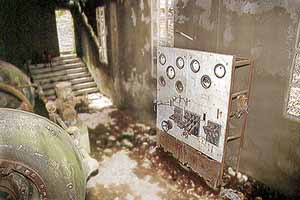
| (13) Overview of the generator room | (14) Outer wall with control panel |
The inner wall of the workfloor is
taken by a symmetrical configuration of turbines and dynamos (13).
Starting from the door we're looking at
|
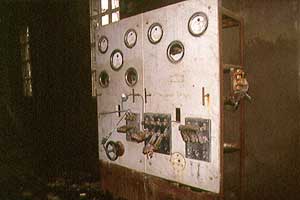
The outer wall (14) is taken by two large windows and two large stone plates - mounted next to each other on a metallic frame - with twin gauges and switches (22). There were also two small regulator wheels (one is now gone) with labels Mas (More, turning left) and Menos (Less). We've found a similar dial, but equipped with English labels, in Arrés. Look there to discover the hidden part of the contraption. |
![]() |
![]() |
|
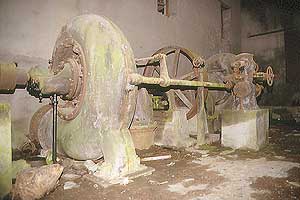
| (15) Turbine left | (16) Controlconsole with turbine right |
![]() |
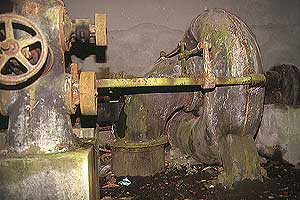
The turbines are
Francis turbines. This type is very common in hydroelectric stations.
Water enters in the outer spiral shaped tube. Guide vanes direct the water
over the runner blades towards the centre of the turbine. The fluid
is then drained through the downward tube.
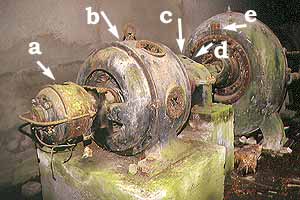
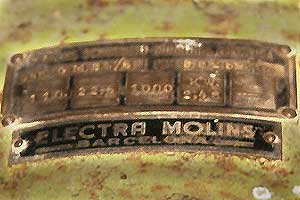
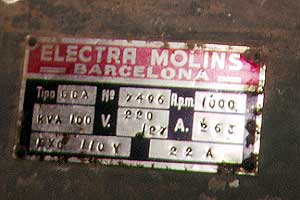
The orientation of the guide vanes is adjustable to adapt the operation of the turbine to changes in the waterflow. The rods to manage the vanes from the central console are shown in both pict. 16 & 15. Several tags are attached to the machinery (17). They give us information about the system and the suppliers. |
|
| (17) Turbine, dynamo and exciter |
![]() |
![]() |
|
| (18) Tag a - exciter | (19) Tag b - dynamo |
|
|
||||||||||||||||||||||||||||||||||||||||
| Electra Molins was founded
in 1948. The company is still active in a related field. It is now specialized in
diesel generating sets.
Siemens Schukert was born in the first years of the twentieth century. Siemens & Halske - active since the middle 1800s - then took over Schuckert & Co - founded in the 1870s - and merged their heavy current business. |
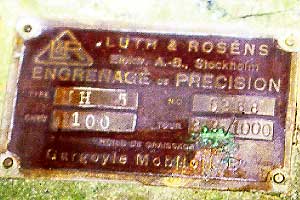
The Swedish agent of Schuckert & Co was
Luth & Roséns Elektriska Ab from Stockholm (20).
Another Swedish company is present in the mill of Arrés.
It is ASEA founded in the 1880s!
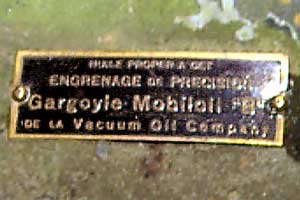
It strikes me that all labels are in French and that the correct brand and type of the lubricant is considered very important (20, 21). Type 'B' is a heavy oil. (Look at some old advertisements for MobilOil in France.) |
![]() |
![]() |
|
| (20) Tag c - gearbox | (21) Tag d - gearbox |
|
Tag 'e' says
|
||||||||||||||||||||||||
![]() |
![]() |
|
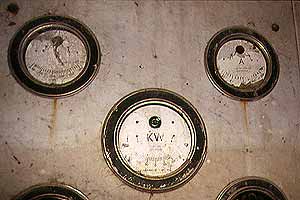
| (22) Control panel with switches and gauges | (23) Gauges for tension, current & power |
| Range of the dials:
+ Tension: 50 - 300 Volt + Current: 40 - 200 Ampère + Power: -100 - +100 KW |
![]() |
![]() |
|
| (24) Detail of exciter | (25) Detail of dynamo |
| waterworks | powerstation | wheat mill |
|
Introduction Learn about the parts of a mill Visit the mills; catalogue Read more about mills; links © and e-mail: |
||
| Next stop on the electricity trail
|