| Nederlands | ![]() |
||||
![]() |
Watermills in Altoaragón - central eléctrica
Arrés |
||||
| Arrés is easily reached from Jaca. Take the main road to Pamplona. After about 20 km
where the road bends right over the bridge (Puente La Reina de Sta Cilia de Jaca), don't
turn but continue straight-on towards Huesca. Almost immediately there-after Arrés is
signposted. Follow the narrow road for about 3 kms until you notice a
patch of trees not too far away to the right. It's before you'll reach the farm houses
and the bend towards the village. The mill is in fact two : a harinero, muy ruinoso, and a powerstation with lots of interesting stuff.
The mill gets water from the Río Aragón.
Pictures: 17.VIII.2003 |
|||||
| waterworks | harinero | central eléctrica |
![]() |
![]() |
|
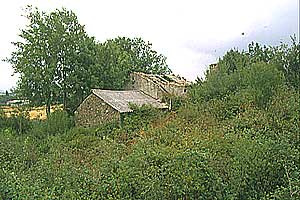
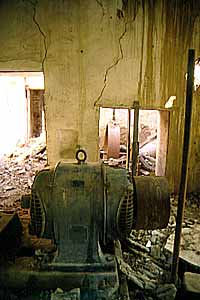
| The powerstation with overgrown embalse (1) | The dynamo with voltage controls and switch room (2) |
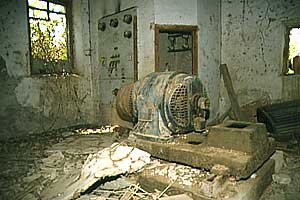
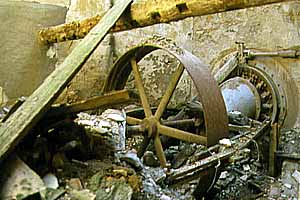
| The powerstation is the part best preserved of this site. It's the small building leaning against the bigger harinero. One enters the engine room from a door next to the milling seat of the flour mill. The central eléctrica is divided in two rooms. Coming from the harinero you'll first enter into the engine room with the turbine (pict. 5) | The next room is the
powerstation proper with a dynamo, a panel with several indicators and
a smaller separate room serving as a switch room. The turbine also was
regulated from this room (pict. 10).
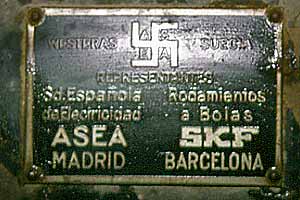
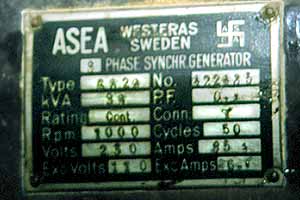
The alternator is a Swedish product and bears two labels. |
![]() |
![]() |
|
| (3) | (4) |
| The first label says: | These are the specs of the alternator: | |||||||||||||||||||||||||||||||||||||||||||
ASEA is shorthand for Allmänna Svenska Elektrifiska Aktiebolaget. The Spanish branch of the company was established in 1914. |
|
|||||||||||||||||||||||||||||||||||||||||||
![]() |
![]() |
![]() |
||
| Dynamo with turbine room behind (5) |
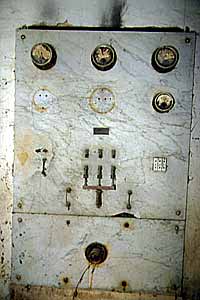
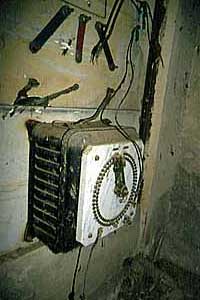
Control panel (6) | Back-side of control panel (7) |
| The Swedish ASEA company
was established in the late 19th century to commercialize Jonas Wenström's power
generation system. It was a three phase AC device and a major improvement compared
with the concurrent systems because of the all-in-one construction of engine, generator
and transformer and also because of the resulting easier transmission of the AC current against the earlier DC current.
Our maps (ed. 1952) show power lines emerging from this Molino de Arrés and running first towards the village of Arrés then Bailo, Arbués and Alastuey, which is quite something. |
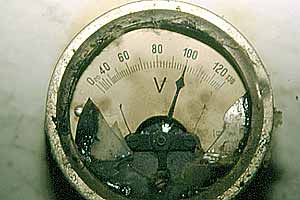
The control panel carries
several dials, switches, fuses in the upper part and one regulator wheel on
the lower part. The wheel features a label telling us to turn left to Raise and right to Lower (Notice the English. In Spain!) This rather modest
wheel sits on a huge regulator switch mounted on the back side of the
plate. The switch counts many double contact points and runs between on
and off. The label located above the central switch says Talleres Electro Mecanicos Zaragoza |
![]() |
![]() |
|
| (8) | (9) |
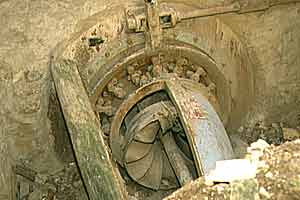
The driving force is delivered
by a turbine (pict. 8) We can appreciate the blades on pict. 9. We've seen several turbines in other watermills, but
most were of a different build (e.g. Nocito, Gistain, Acumuer).
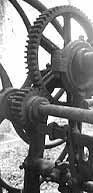
A belt ran over the huge driving-wheel mounted on the axis of the turbine (See also pict. 5). The turbine was regulated with a rod that could be adjusted by means
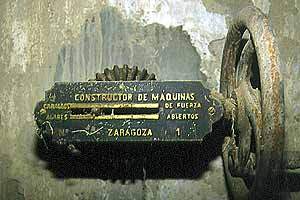
of a wheel with gauge (pict. 10). There is no detailed scale marked on the gauge.
The text readsConstructor de maquinas |
The turbine carries two more labels. The small black one says José AmorosThe slightly bigger reddish label says Talleres Martin |
![]() |
![]() |
|
| Regulator of the turbine (10) | Voltage meter (11) |
| waterworks | harinero | central eléctrica |
|
Introduction Learn about the parts of a mill Visit the mills; catalogue Read more about mills © and e-mail: |
||
| Next stop on the electricity trail
|