| Path: Introduction - Visit the mills; catalogue - Caballera | ![]() |
Nederlands | ||||
![]() |
Mills in Altoaragón - harinero
Caballera |
|||||
| Caballera is a village
in the Sierra de Campanúe not far from Santa Liestra. It's a very pleasant walk from
Troncedo on the road between Tierrantona and Graus. Try to find
a GR-1 signpost in the village center of Troncedo. Follow the path to the north towards
Formigales. You'll walk on an old cabañera and soon reach a small pond fed by a
well. At that point a track emerges from the east. It's the road towards Caballera and
it coincides for some time with the GR. Stick to it when a bit farther it turns east
again away from the GR-1. After quite some time you'll see the stony flats in the
valley at your right side. Work your way down through the terraces.
Pictures: 03.VI.2003 |
||||||
![]() |
![]() |
||
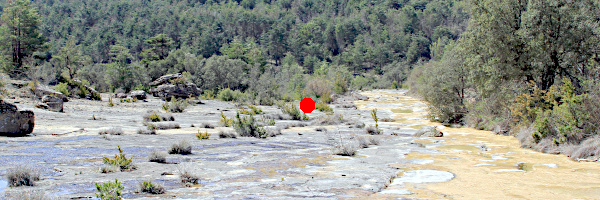
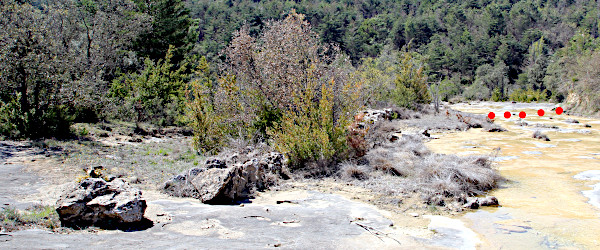
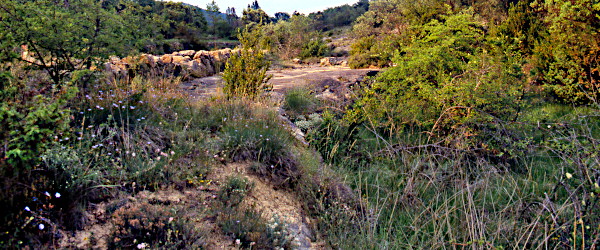
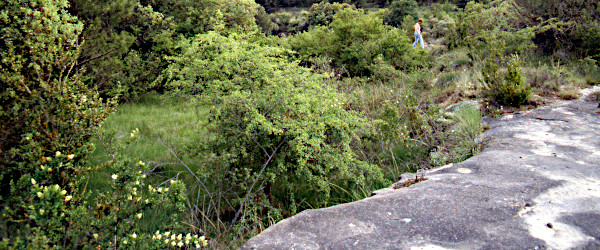
| Barranco Bobatialla (?) Mill is at the bottom. | Reservoir, dike and place of barrage (left to right) | ||
![]() |
Not much did survive
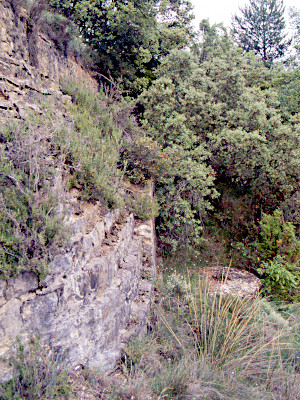
but what remains of the mill of Caballera is impressive. The mill was situated
below the steep ridge of a huge stony flat and therefore invisible from above.
At the right side of the slope a small rivulet carries some water, but as the slope collects water from a large part of the hill,
the mayor energy source was probably rainwater.
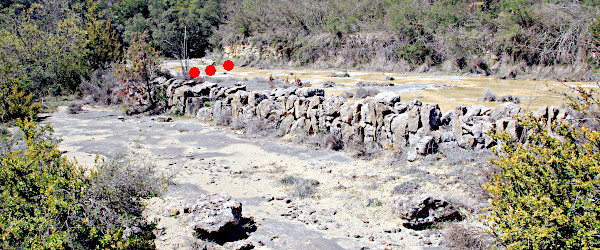
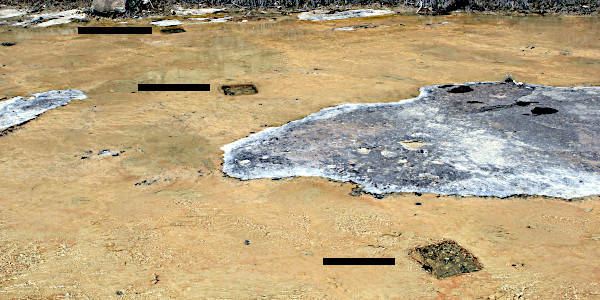
In the center of the bed a dike was constructed (white arrow). Water arriving left from it, went directly into the reservoir (black arrow). The dike longs the ridge and prevents the water from generating a nice, but useless, cascade. Square holes in the rock witness the presence of a barrage (black line) forming a second reservoir. I'm not sure that this second embalse had anything to do with the mill. I couldn't find any clear channel leading to the mill and the barrage, compared with the first embalse, lies a bit too low to make full use of the capacity. (Find other pole-feet in Lecina, Puyarruego) |
| footprints of old barrage |
![]() |
![]() |
||
| Barranco upstream from former barrage; centerdike at right. |
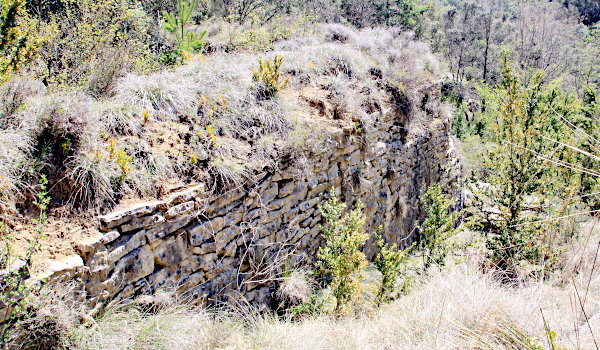
Embalse; person standing on enclosing wall | ||
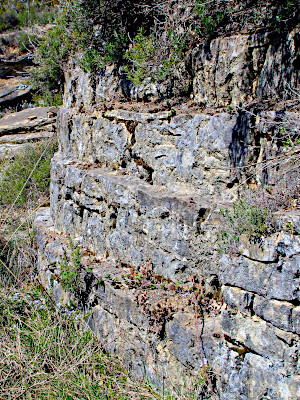
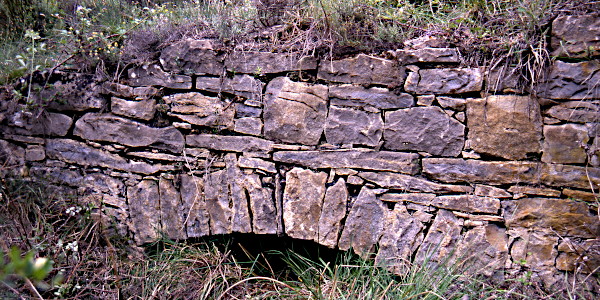
| The embalse is most interesting. It's built where the flat drops down. It rests against the cliff and water arriving left from the middle ridge directly falls in. From below a thick wall was erected reaching the level of the river-bed. This made for an important volume together with a big depth and high pressure. | The wall consists of more or less regular building blocks in several layers. The top layers tend to be a bit less thick. It's one of the best made reservoirs I've ever seen. (Other examples: Abiego, Samper, Alquezar.) Look at the people to appreciate the dimensions. Trees are now taking the place of the water. |
![]() |
![]() |
||
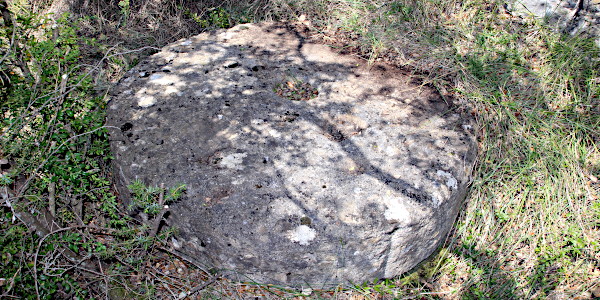
| Embalse | Embalse; arrow points to mill stone | ||
![]() |
![]() |
||
| Embalse | Millstone | ||
![]() |
The mill must have been built next to the embalse (white arrow). Nothing is remaining but a couple of milling stones. Two monolites betray the place of the workplace. They lay in the original position above the cárcavo which is filled with decaying plant material. Notice here also the nice masonry. | ||
| Cárcavo | |||
|
Introduction Learn about the parts of a mill Visit the mills; catalogue Read more about mills © and e-mail: |
||
Path: Home / Altoaragón: old watermills |