Mills in Altoaragón - harinero, central eléctrica

Puyarruego

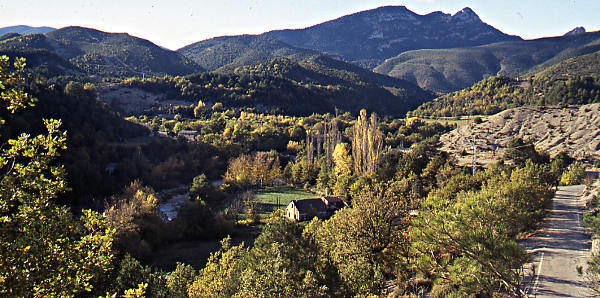
Puyarruego is on the road toward the famous Garganta del Añisclo (Vallée de la Niscle for the French). Leave L'Ainsa towards Bielsa and the French border. Turn left in Escalona and follow the road until you reach the branch leading into the village. Park your car at the dedicated spot just before the bridge. It could be a bit crowded because this is one of the most popular beaches in the Sobrarbe region. The mill is in the river bed and gets water from the Río Vellos.
The mill is ideally situated to become a visitor center for the Ordesa National Park.

Pictures: I.1998, III.2000, VII.2000, XI.2004, XI.2005

 
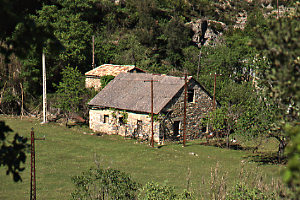
(1) Mill of Puyarruego from the East (2) Mill of Puyarruego from the South
 
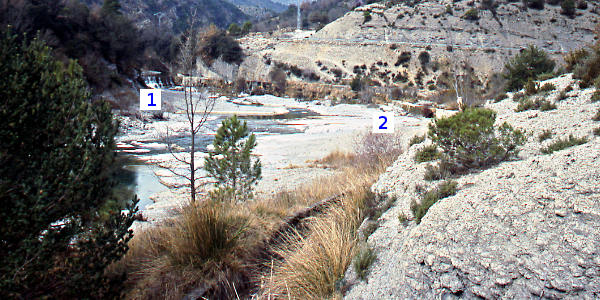
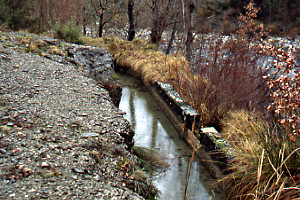
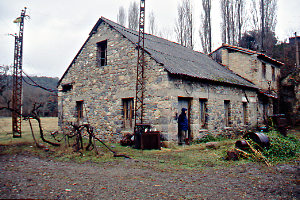
Walk to the bridge. The canal runs under the bridge. It comes from the right where it takes water from the Río Vellos which is left in picture 1 and on the foreground in pict. 2. A path, longing the canal to the left brings you to the molino (red arrow). The complex counts two small constructions. The harinero (3, 4) is the smallest construction with the round tiles which are normally only found more to the south (see Naval, Sarsa) The powerstation is much more spacious with a roof of corrugated Uralita.
 
(3) Mills of Puyarruego from the East (4) Mills of Puyarruego from the South
 
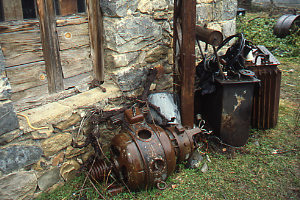
The mill dates from the 16th century. In 1920 she was converted to power station. The map (edition 1952) shows a powerline running to the south and reaching San Vicente near Labuerda. There was a branch leading towards Muro de Vellos, a village you can from Puyarruego. The generator was shut down in 1980. Both mills were securely locked up so I couldn't enter. I could peer through a chink into the power station and it looks like most machinery is dismantled. A generator and some other stuff is lying outside against the wall (pict. 7). Notice also the old rusty pylons (pict. 3, 4). There is another one in the village.
 
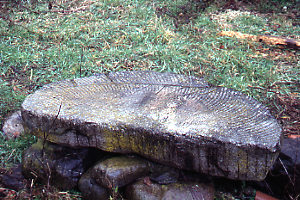
(5) Old milling stone (6) Old milling stone; ridges still visible
 
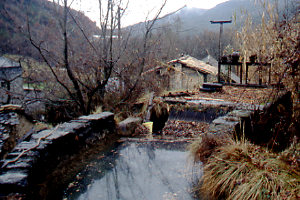
Outside the flour mill we've found two broken milling stones. Unlike many others they haven't found a second life as picnic table (see Sarvisé, Allué and many other places). On one of them the ridge pattern is still clearly visible. Try to make your way behind the harinero and up the slope towards the end of the water supply channel (8). The canal is broad and deep and ends level with the roof. There is no embalse to store water because the river is never without. This mill wasn't likely to have trouble with power shortage. At the time of our visit the canal had ondergone some maintenance, but it was clearly not done by a qualified person.
 
(7) Generator and other stuff (8) End of the supply channel
 
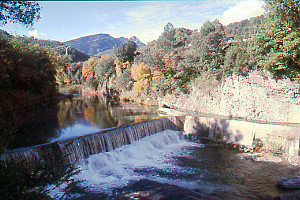
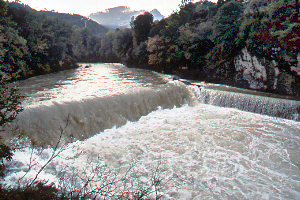
The channel is over most of its length in quite a reasonable shape. It follows the left bank from the mill (blue dots in pict.2), then under the bridge and further stream up until it reaches the Río Airés a tributary of the Río Vellos (pict. 13). There the channel has to go underground and resurface again at the other side. It then continues (blue arrows) and reaches the dam after another 100 meters. The dam (presa) is situated several hunderd meters upstream. Pictures 9, 10 and 11 show the dam and the first few meters of the channel. They also illustrate that the amount of water in the river is quite variable.

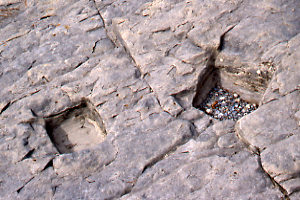
The dam wasn't always at the same spot. At several places in the riverbed there are clearly man-made holes (pict.12). They indicate the position of previous dams. Visit the page of Javierre de Olsón for similar holes with one of the poles still in place.

 
(9) Dam November 2004 (10) Dam November 2005
 
(11) Dam March 2000 (12)
 
This mill once was the property of Ramón de Mur, barón de Pallaruelo. Visit Escalona to learn how he took possession.
(13)
 

Next stop on the electricity trail or learn more about Puyarruego.

Path: Home / Altoaragón: old mills